Common Bronze-winged Pigeon (Phaps chalcoptera)
The bronze-winged pigeon (Latin: Phaps chalcoptera) is a species of the pigeon family, endemic to Australia. No subspecies are recognized. It is one of the most widespread pigeon species in the country, found across almost the entire Australian mainland and in Tasmania, except in dense, wet tropical forests.
Appearance
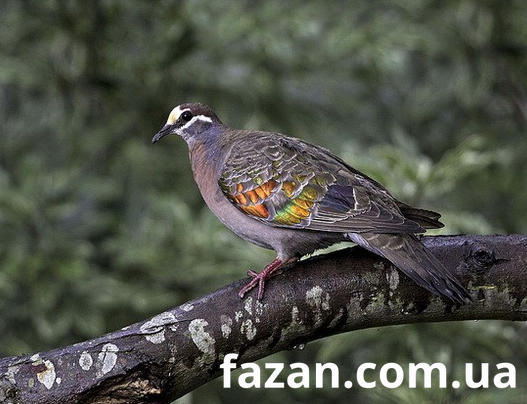
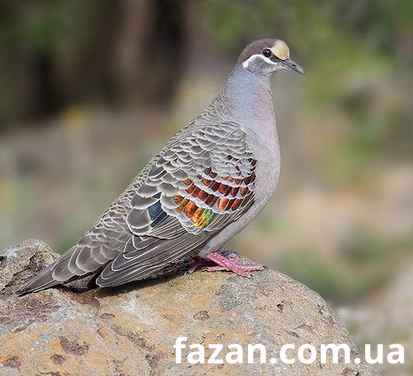
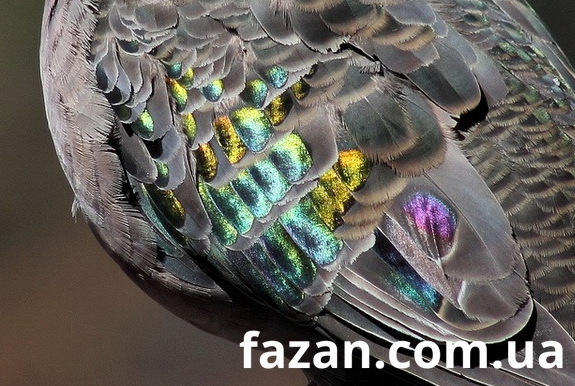
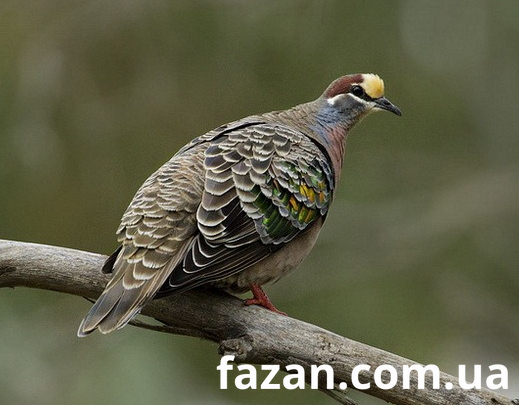
Body length ranges from 28–36 cm; males weigh 331–356 g, females 310–333 g. Sexual dimorphism is weakly expressed. Adult males have a white forehead with a golden-beige tint, bordered by a dark purple stripe; the rest of the head and neck are brown. A short white line extends from the bill to the back of the eye. The chin and upper throat are white; the sides of the neck are blue-gray. The upper body is olive-brown with broad brown scalloping, and the wings display iridescent green, yellow, bronze, and purple markings. The breast and flanks are pinkish-brown, and the underparts are bluish-gray. The bill is dark brown, and the legs and feet are pinkish-red. Females and juveniles have duller plumage.
Distribution and habitat
Endemic to Australia, the species occurs in forests, sclerophyll shrublands, coastal heathlands, saltmarsh plains, and open grasslands with scattered shrubs and trees. It is also commonly found in modified habitats, including agricultural lands, gardens, and along roads. It is absent from dense, wet tropical forests.
Diet
Bronze-winged pigeons feed primarily on the ground. Their diet consists mostly of seeds, with some leaves and occasional insects. In agricultural areas, key foods include wheat, weed seeds, and seeds of shrubs such as acacias and cassias. In arid regions, acacia seeds and seeds of plants from the Rutaceae, Asteraceae, and Poaceae families are important food sources.
Behaviour and biology
The species is mostly sedentary but can be locally nomadic. In southwestern Western Australia, seasonal migrations occur depending on temperature. Flight is fast, with continuous wingbeats. The main call is a low, hooting sound lasting about 0.75 seconds, repeated every 2–3 seconds, and a growling call is produced when threatened.
Habitat of the Bronze-winged Faps Dove