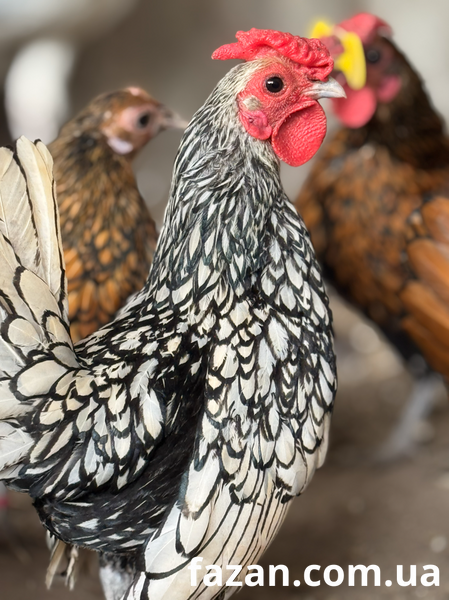
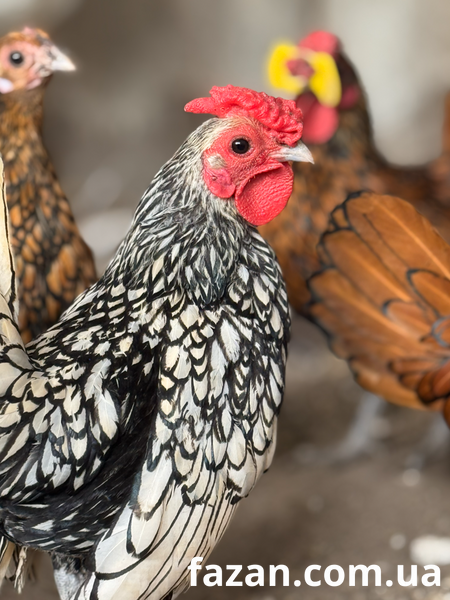
The Silver Sebright is a miniature bantam chicken, prized for its elegant “laced” feather pattern and refined breed type. The birds are compact, proportionally built, with a decorative silhouette and equally full plumage in both sexes. The hallmark of the breed is that each feather has a silver base color with a uniform black edging, creating a unique lace-like pattern.
Breed History
The breed was developed in England in the early 19th century by Sir John Sebright, who spent over 15 years selectively breeding miniature birds with clear feather edging. The work involved crossing bantams with Hamburg and Polish chickens, followed by multi-generational inbreeding and strict selection. By 1815, stable color varieties — gold and silver — were established, and the breed received official recognition, becoming the first ornamental line named after a person. Popularity among the aristocracy helped Sebrights spread quickly across Europe and gain a reputation as one of the most striking miniature breeds.
Breed Standard
Body type: firm or dry, short and compact, with a straight back line. Average weight: roosters 450–600 g, hens 400–500 g. Sexual dimorphism is moderate: roosters slightly larger, with a more developed rose comb of bright red color and spurs; hens have a very small pale comb, no spurs.
Appearance
Head is light and wedge-shaped; beak of medium length, slightly curved, matching the plumage color. Eyes are large and dark; earlobes and wattles are medium, usually red. Neck is thin and held high. Wings are full, with long flight feathers, slightly drooping and not touching the ground; tightly held wings are considered a fault. Legs are thin, medium length, unfeathered; shanks and claws are gray or bluish-gray. Tail is long, with evenly rounded feathers, seven on each side; spurs on the tail of roosters are not allowed.
Plumage
Dense and glossy. Two color varieties are recognized: silver and gold. The silver Sebright has a light base feather color with even black edging on each feather, creating the characteristic lace effect.