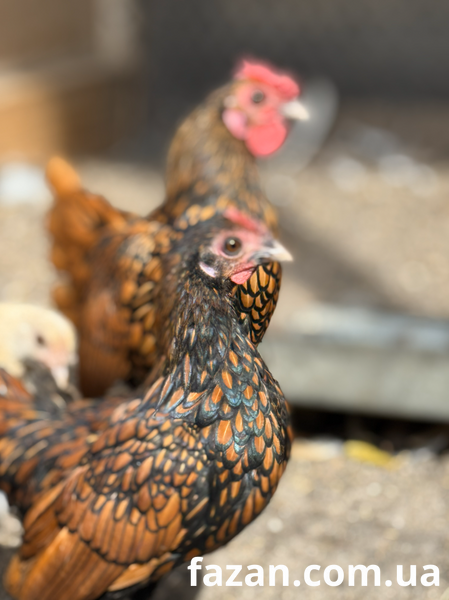
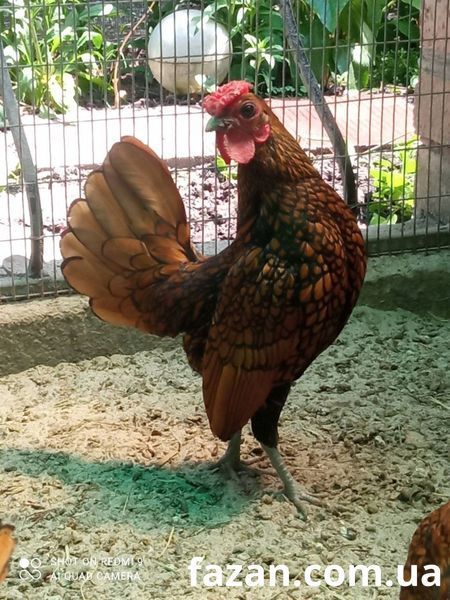
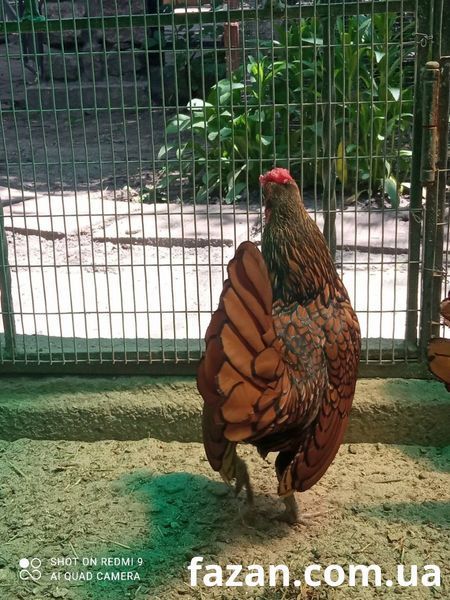
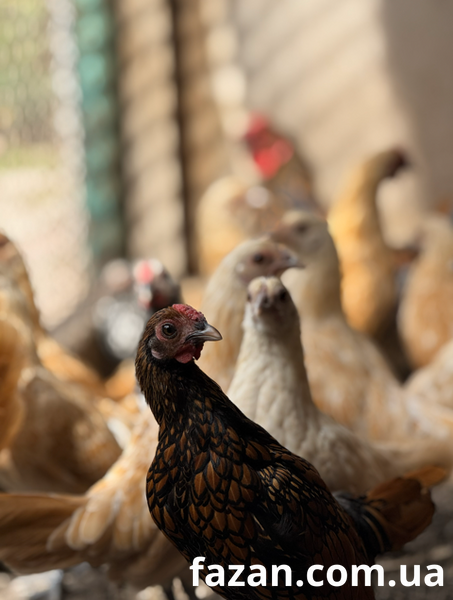
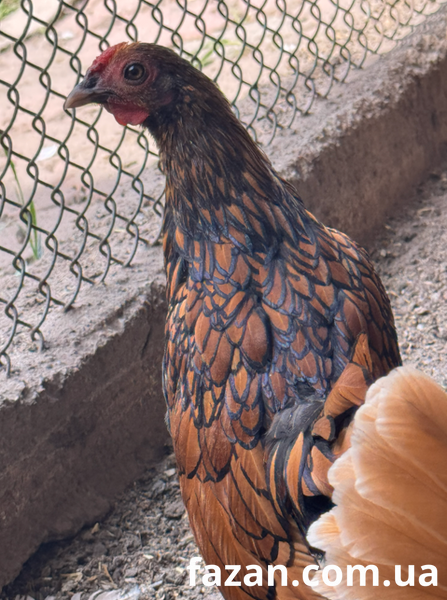
The Golden Sebright (English: Sebright) is a bantam chicken breed developed in England. The breed was created by John Sebright and first exhibited in 1815. These birds are originally miniature in size.
Appearance
Both sexes have the same feather type: roosters have no pointed feathers on the hackle, back, or tail. Roosters and hens share the same elegant lacing on each feather. The body is compact, short, and well-rounded, with a prominent chest and upright posture. The tail is fan-shaped, broad at the base, with seven tail feathers on each side; in young roosters, the upper tail feathers may rise about 2 cm above the others. Wings are dropped, nearly touching the ground, and loosely held against the body.
Undesirable traits include: large, coarse, or long body; wings held too high or tightly against the body; lack of feather lacing.
Productivity
Hens display strong brooding instincts. They lay 60–90 eggs per year, weighing about 30 g, white or slightly yellow. Average weight: roosters 0.6 kg, hens 0.5 kg. Ring size: 11 mm for roosters, 9 mm for hens. Due to their small size, Sebrights are capable of flying almost as well as pigeons.